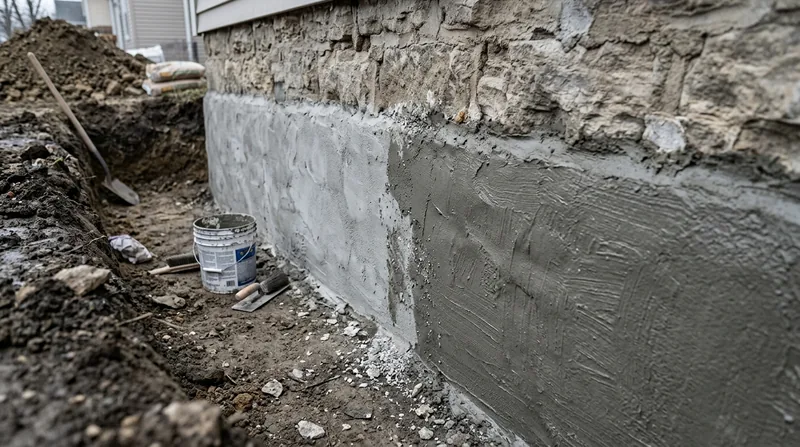




Foundation Waterproofing in Bloomington starts with reading the ground. Most of this city sits on glacial till and silty clay loam, a flat prairie soil that drains slowly and holds spring meltwater against the wall base for weeks. The housing stock tells the rest of the story: stone and brick foundations near Downtown and Franklin Park, early block walls around Illinois State University, poured concrete full basements in the north and west subdivisions. Each one fails differently, and each one needs a different fix. We work below grade only, on the foundation and the drainage that surrounds it. If water is finding its way in, start with a free basement inspection before anyone quotes you a repair.
Why Foundation Waterproofing Matters on Bloomington's Clay Prairie
Hydrostatic pressure is the dominant failure mode here, not rainfall alone. Glacial clay soil absorbs slowly and releases slowly, so the water table stays high through March and April and pushes laterally against basement walls long after the rain stops. On 1900s brick and stone walls, that pressure finds the mortar joints first. On poured walls in the newer west-side subdivisions, it shows up as seepage at the cove joint and hairline shrinkage cracks. The freeze-thaw cycle then widens what pressure started, especially on older block walls that were never parged or damp-proofed.
- White efflorescence on the wall face means water is moving through the masonry and depositing salts as it dries.
- A musty basement smell after snowmelt usually points to chronic seepage at the wall base, not a single leak.
- Rust stains or a water ring inside the sump basin tell you the pump has been cycling hard and may be near failure.
- Hairline cracks that reappear each winter on 1950s ranches on the east side are classic freeze-thaw openings.
- Water pooling in a low corner after heavy rain often traces to a failed footing drain, not the wall itself.
Sorting pressure-driven seepage from a simple crack changes the whole scope, and that diagnosis comes before any quote.
Key info: A 1920s foursquare near Franklin Park with a fieldstone wall and failing mortar needs repointing and parging, not the same treatment as a 2005 poured wall in northwest Bloomington with a cove joint leak. Matching the method to the wall type is most of the job.
For local code questions on structural repair and drainage alterations, the City of Bloomington building department is the authority to check before work begins: cityblm.org.
How We Diagnose and Waterproof a Bloomington Foundation
We start at the wall, not at the truck. The first pass is a walk of the interior perimeter to map seepage height, efflorescence patterns, and crack locations, then an exterior look at grading, downspout extension, and window well depth. On homes around Illinois State University, that often means checking a partly finished basement where the seepage hides behind framing. We test whether the wall is taking water through the face or at the base, because the answer decides between surface treatment and drainage correction.
- We map every crack and wet zone and note the wall material, stone, brick, block, or poured concrete.
- We check the sump basin, pump operation, check valve, and discharge line for capacity and freeze exposure.
- We inspect exterior grading and downspout extension to see how much surface water is being dumped at the wall.
- We recommend the narrowest fix that solves the actual problem, crack injection for a single moving crack, drainage for pressure.
- We schedule the work, pull any permit the local building department requires, and clean the site before we leave.
Not every wet wall needs excavation, and we say so when a $600 injection job will do the work.
Key info: A split-level in Hudson with water only at one corner after heavy rain usually has a downspout dumping at the foundation and a failed footing drain at that corner. Extending the downspout and repairing the drain tile solves it without touching the rest of the wall.
When the diagnosis points to perimeter drainage, the right next step is an interior drain tile system, which captures water at the cove joint and routes it to the sump without excavating the yard.
Waterproofing Methods We Use by Foundation Type
The method follows the wall, the water source, and the budget. Here is how the main approaches compare on Bloomington foundations, from fieldstone near Downtown to poured concrete in the newer subdivisions.
| Approach | Description | Best for |
|---|---|---|
| Epoxy or polyurethane injection | Ports drilled along the crack, resin injected to fill and seal it from inside | Individual cracks in poured or block walls, not broad seepage |
| Parging and masonry repair | Repoint mortar joints and apply a parge coat matched to the original wall | Fieldstone and brick walls in pre-1940 homes near Downtown |
| Interior perimeter drain | Drain tile at the cove joint feeding a sump basin and pump | Hydrostatic pressure and water at the wall base |
| Exterior membrane and dimple board | Waterproof membrane over the wall face with drainage board and footing drain | Major exterior water load and failed original footing drain |
| Crystalline or cementitious coating | Surface-applied treatment that seals the concrete face against seepage | Damp poured walls without an active water path |
Foundation Waterproofing Cost in Bloomington: What to Expect
Most single-crack injections and small surface repairs in Bloomington start around $600, while a full perimeter solution starts from $3,500. That starting figure reflects the labor and material for a wall face treatment or a drainage correction on a standard basement, and it moves with the actual scope. The big cost drivers here are foundation type (fieldstone and brick take more labor than poured), how much wall is wet, whether the footing drain has failed, and how much interior finish has to come out. Access matters too: a narrow lot near campus or a finished basement with framing in the way adds time.
Get two or three written estimates before you commit, and ask each one whether the diagnosis is pressure or a single crack. A contractor who quotes drainage for a hairline crack, or injection for a wet base, is guessing. Our full pricing overview breaks down the ranges by method.
Hiring a Waterproofing Contractor Near Me in Bloomington
Waterproofing is a below-grade specialty, not a general handyman job. Ask for the Illinois license and a certificate of insurance before anyone walks your basement, and confirm the crew will be on site, not a subcontractor you have not met. Check references on homes with the same foundation type as yours, because a fieldstone specialist and a poured-wall specialist are not interchangeable. Ask who pulls the permit if the work alters structural repair or the sump discharge connection, and confirm the local building department's rules before work starts. A transferable warranty in writing is standard; be wary of anyone promising a lifetime guarantee.
Ready to get a real diagnosis? Reach out through our contact and free estimate page and we will schedule a look at your foundation.
Foundation Waterproofing in Bloomington: Pricing Guide
| Service | Price | Details |
|---|---|---|
| Crack injection (single crack) | Starting at $600 | Epoxy or polyurethane injection on one crack, price rises with crack length and wall thickness |
| Wall face treatment | Starting at $1,800 | Parging, sealing, or crystalline coating on one wall face, driven by wall type and surface prep |
| Perimeter drainage correction | Starting at $3,500 | Interior drain tile and sump tie-in on a standard basement, scope and finish removal move the price |
| Exterior membrane and drain | On estimate | Excavation, membrane, dimple board, and footing drain need an on-site look before a number is given |
| Travel | Included | in Bloomington and surrounding areas, no separate call-out or mileage fee |
| Estimate | Free | Response within 24h at (309) 807-1768, no obligation to book |
Indicative pricing, the exact cost depends on square footage, finish, and site access. Free personalized estimate within 24h at (309) 807-1768.


